

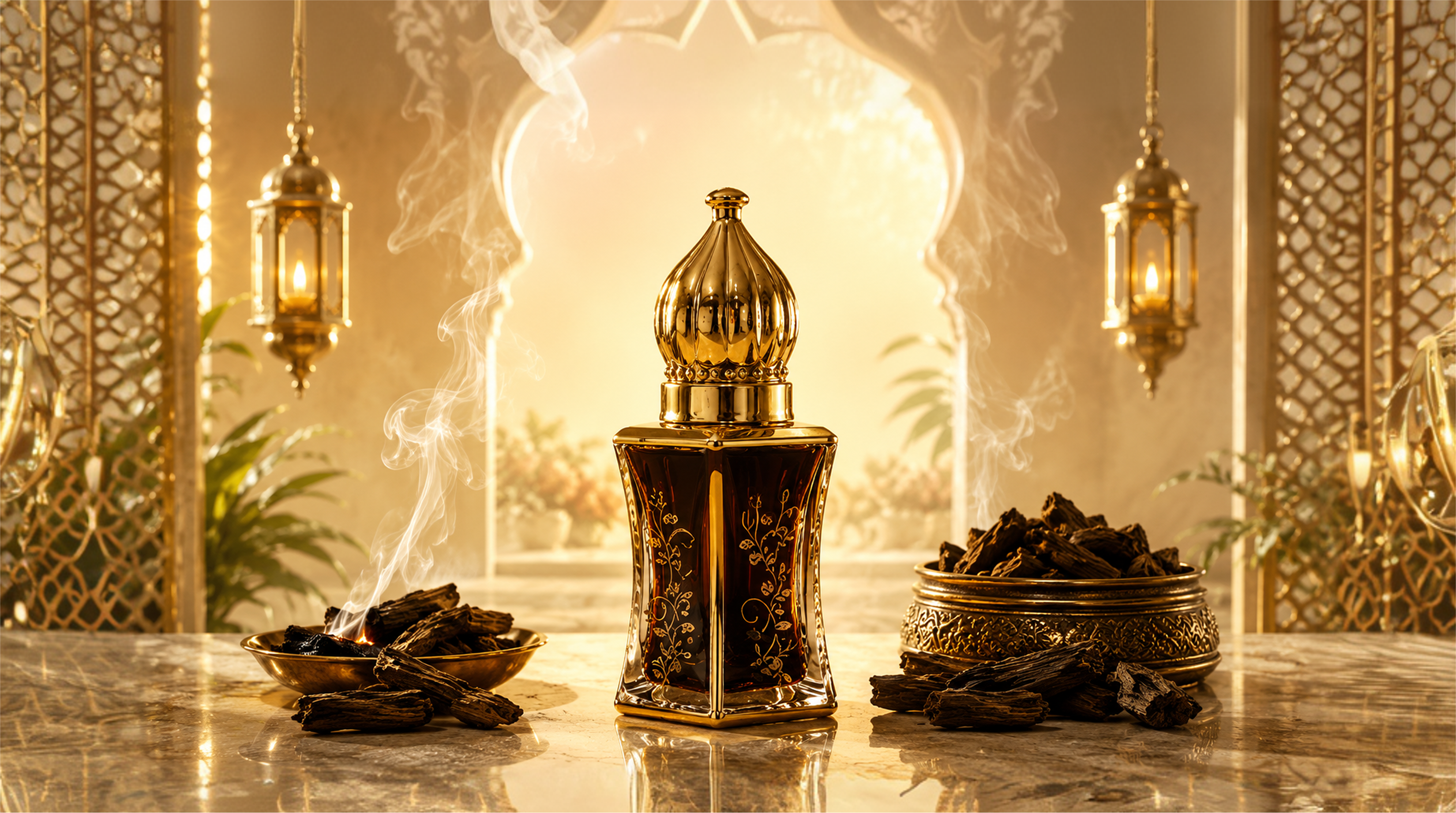
Once worth more than gold by weight, oud has journeyed from the royal courts of the Middle East to the vanity tables of Paris and London. But what exactly is it — and why does it smell unlike anything else on earth?
If you've ever smelled a fragrance that stops you mid-sentence — something smoky, animalic, woody, and almost impossibly complex — there's a good chance oud was involved. It's the ingredient perfumers fight over, collectors hoard, and first-timers find utterly bewildering. This guide covers everything you need to know.
Oud (also spelled aoud, and known by its scientific name Aquilaria) is a resinous heartwood that forms inside certain Southeast Asian trees — most commonly found in India, Bangladesh, Laos, Cambodia, and Vietnam. Here's the twist: healthy Aquilaria trees produce no oud at all.
The precious resin only forms when the tree comes under attack — typically from a specific mould (Phialophora parasitica). As a defence mechanism, the tree saturates its heartwood with a dark, aromatic resin. The longer this process continues, the richer and more complex the oud becomes. The finest specimens may take decades to develop.
In the wild, only roughly 7% of Aquilaria trees ever develop oud. This extraordinary scarcity is what pushes authentic Cambodian or Vietnamese oud to sell for more per kilogram than most fine metals.
Quick Fact
The term "oud" comes from the Arabic عود, meaning "wood" or "stick." In Western perfumery, you may also see it labelled agarwood or aloeswood. They all refer to the same thing.
What Does Oud Smell Like?
This is the question every beginner asks — and the honest answer is that it depends enormously on origin, age, and processing method. But some descriptors come up again and again:
● Woody and smoky — a deep, almost campfire-like depth
● Animalic and leathery — particularly in raw Indian oud, which can verge on barnyard
● Sweet and fruity — especially Thai and Cambodian oud, which carry notes of dried fruit
● Incense-like — a sacred, meditative quality common in Middle Eastern ouds
● Slightly medicinal — some wearers detect a faint iodine or antiseptic edge
Importantly, oud behaves differently on skin than in the bottle. It is a base note that evolves for hours, often revealing entirely new facets as it dries down. Give it time.
"Oud is not one smell. It is a conversation between the tree, the soil, the decades of waiting, and finally, your skin."
Types of Oud by Origin
Serious oud enthusiasts are as precise about provenance as a sommelier discussing wine
regions. Here's a rough guide:
Oud Oil vs Oud in Perfumery
Oud is used in two primary forms in the fragrance world. The first is pure oud oil (known as dahn al oud in Arabic) — extracted through steam distillation or hydrodistillation of the resinous heartwood. A single gram of the finest quality can fetch hundreds of pounds. These oils are typically worn neat, applied to pulse points with a small dabber.
The second is oud as a note in an eau de parfum. Here, perfumers — especially at niche houses — blend oud oil or synthetic oud molecules with other ingredients to create a composition. This makes the ingredient accessible to a wider audience and allows for extraordinary creative expression. Think of Tom Ford's Oud Wood as an entry point, and Roja Dove's Aoud as the deep end.
Synthetic Oud: Friend or Foe?
Given the scarcity and cost of real oud, many perfumes — including some very expensive ones — use synthetic oud molecules such as Agarwood MD or Iso E Super variants. This is not inherently a problem. A skilled perfumer can use synthetics to create something beautiful, and it also helps protect wild Aquilaria populations from over-harvesting.
At ScentGrade, we always specify whether a fragrance uses natural or synthetic oud in our ingredient breakdowns, so you can make an informed choice.
How to Wear Oud
A few practical notes for the newly converted:
● Less is more, especially with pure oil. One tiny application to the inner wrist can project for eight hours.
● Warm skin amplifies it. Apply after a shower when pores are open. Your pulse points (wrists, neck, inner elbow) will do the rest.
● Be patient with it. The dry-down on oud-heavy fragrances can take 20–30 minutes to stabilise. Reserve your judgement.
● Start with Cambodian. If you're new to oud, Indian-origin ouds can be confronting. Cambodian oud is sweeter, cleaner, and much more forgiving for beginners.
Frequently Asked Questions About Oud
Is oud only for men?
Not at all. While oud has strong roots in Middle Eastern masculine tradition, many of the world's most celebrated oud fragrances are marketed as unisex or feminine. The ingredient itself is entirely gender-neutral.
Why is oud so expensive?
Because of its extreme scarcity. Only a tiny fraction of wild Aquilaria trees ever produce oud, and formation takes decades. Combine that with high global demand and the labour-intensive extraction process, and you have one of the most expensive natural ingredients on earth.
How can I tell if a perfume contains real oud?
Look for "Aquilaria agallocha" or "Aquilaria malaccensis" in the ingredient list. Marketing terms like "oud-inspired" or "woody oriental" often signal synthetic alternatives.
Does oud smell bad at first?
Some people find raw Indian oud animalic or challenging on first encounter. This is completely normal — oud is an ingredient that often rewards patience. Many wearers who initially recoil end up completely devoted to it after a few wearings.


