

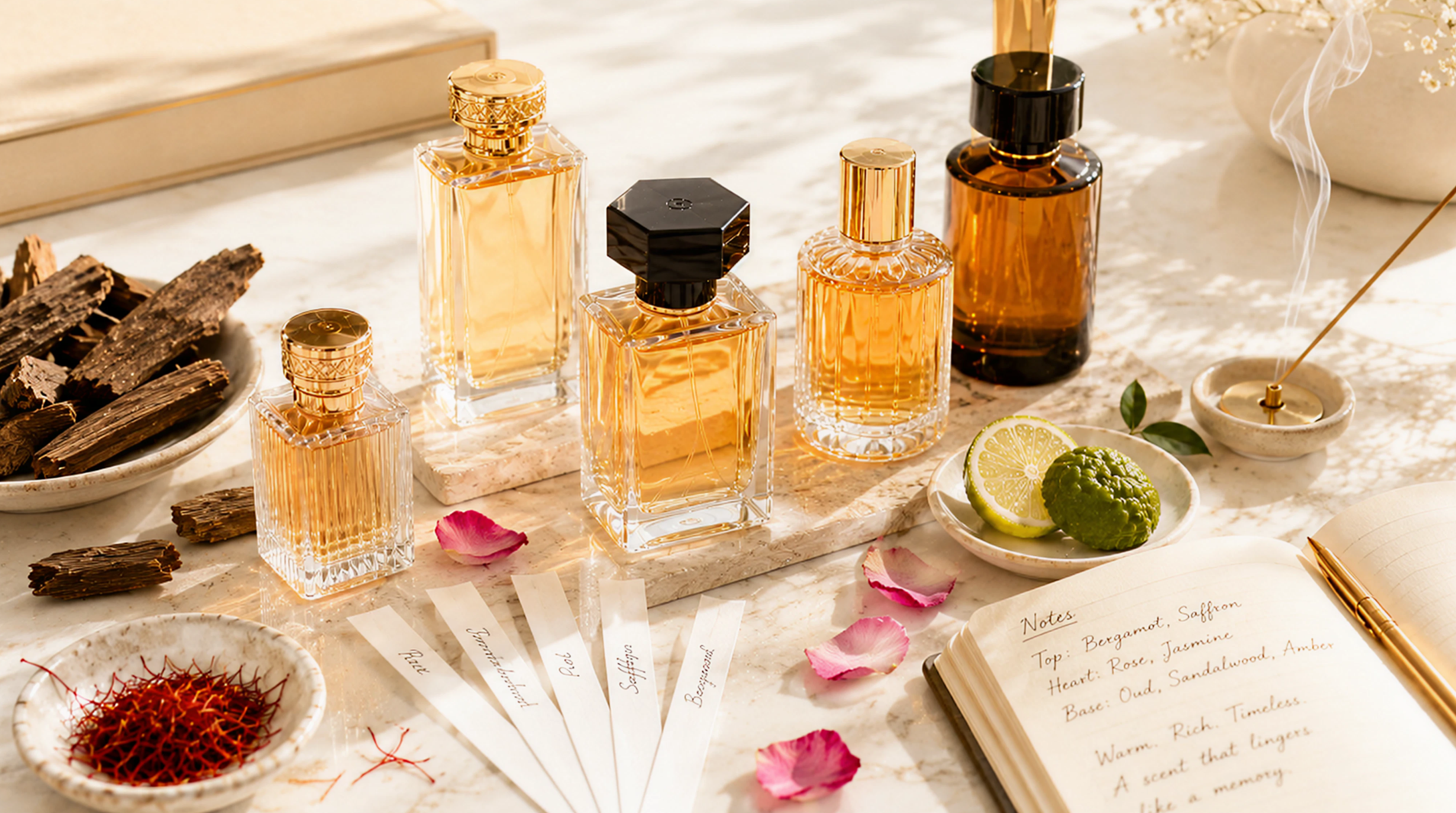
Most people arrive at their signature fragrance by accident. This guide is about doing it on purpose — understanding what you're drawn to, testing the right way, and eventually landing on the scent that feels unmistakably like you.
A signature scent is not simply a fragrance you like. It's the one that people associate with you — the one you reach for without thinking, that layers invisibly into how you present yourself to the world. For some people it takes years to find. For others, the first sample they ever wore on skin was it.
The difference, almost always, is method. Wandering through a department store and spraying strips of paper is not a reliable path. This guide is. Six steps, taken in order, will get you from "I don't know where to start" to "this is the one" faster than any amount of random browsing.
Step 1
Understand the Fragrance Families
Before you can find what you want, you need a language for describing what you already like. Perfumers organise fragrance into families — broad categories that describe a scent's dominant character. Knowing which families you're drawn to (even instinctively, even based on candles or shampoos) is the most efficient starting point possible.
These are the six families most relevant to niche fragrance shopping:
Woody
Sandalwood, cedar, vetiver, oud, patchouli. Grounded, warm, masculine or unisex.
Floral
Rose, jasmine, iris, tuberose. Feminine-leaning but many modern florals are unisex.
Citrus / Fresh
Bergamot, yuzu, grapefruit, green notes. Clean, energising, great for warm weather.
Oriental / Amber
Amber, vanilla, musk, benzoin, labdanum. Warm, sensual, long-lasting.
Arabic / Oud
Oud, rose, saffron, incense. Rooted in Gulf tradition — rich, intense, ceremonial.
Aromatic / Green
Herbs, moss, tea, grass. Clean and intellectual — often a favourite with minimalists.
You don't need to pick one. Most people are drawn to two or three families. Knowing this shapes which samples to order, and saves you from wasting time (and money) on fragrance families that have never spoken to you.
Step 2
Understand Your Skin Chemistry
This is the step most beginners skip — and the reason so many people end up disappointed by a fragrance that smelled wonderful on someone else.
Fragrance doesn't exist in a bottle. It exists on skin. Your skin's pH, temperature, moisture level, and even your diet all affect how a fragrance develops from spray to dry-down. A rose note that smells powdery and elegant on one person can smell sharp and medicinal on another. Sandalwood that reads as creamy and warm on warm skin can smell almost plasticky on dry, cool skin.
What this means practically: never buy a fragrance you haven't worn on your own skin for at least four hours. Paper strips tell you almost nothing useful. A quick wrist spray in a shop tells you only the top notes — the first 10–15 minutes. The heart and base notes, where the real character lives, only emerge after half an hour or more. Your signature scent is in the dry-down.
| Skin type | How it affects fragrance | What this means for you |
| Dry skin |
Fragrance fades faster; musks and base notes project less |
Favour Extrait de Parfum concentrations; moisturise before applying |
| Oily skin |
Fragrance holds longer; base notes amplify |
Lighter concentrations work well; heavy ouds can become overwhelming |
| Warm body temp | Projection increases significantly; spicy and woody notes open faster | Apply less — one spray, not three |
| Cool body temp | Fragrance stays closer to skin; soft musks and sandalwood stay intimate | Apply to pulse points for best diffusion; consider layering |
Step 3
Order Samples — Not Full Bottles
This is non-negotiable for niche fragrance. Full bottles are expensive. Samples are not. The correct order of operations is always: sample first, bottle second.
At Scent Grade, every fragrance is available as a 2ml decant — enough for two or three full wearings. The Discovery Sets are particularly useful here:
pre-curated collections of samples grouped by family or mood, designed exactly for this purpose. They take the selection work off your plate and put a range of options in your hands for less than the cost of one full bottle.
Order three to five samples from the families you identified in Step 1. No more than that in a first round — the goal is depth, not breadth. You want to understand each fragrance properly, not skim across a dozen of them.
How to sample correctly
One fragrance per arm, one per day. Apply to the inner wrist or inner elbow — both areas provide warmth and good projection. Do not rub. Let it dry naturally.
Smell it at 15 minutes, 1 hour, 4 hours, and end of day. Note how it changes. The fragrance that has fully opened and settled by the four-hour mark is the one you should be paying attention to, not the one that smelled best on first spray.
Reset your nose between sniffs. Smell the inside of your elbow or your own clothing — areas with no fragrance applied — to clear your olfactory palate between each evaluation.
Step 4
Pay Attention to Emotional Response, Not Just Smell
Fragrance is more connected to memory and emotion than any other sense. A signature scent isn't simply one that smells good — it's one that makes you feel like yourself. This distinction matters more than most guides acknowledge.
When you wear a sample through a full day, ask yourself questions beyond "do I like this?" Ask: Does wearing this make me feel more confident? More relaxed? More present? Does it suit who you are at work, at home, in the evenings? Would you feel comfortable if someone commented on it? Do you keep reaching down to smell your own wrist?
That last one is the most reliable test in fragrance. The fragrance you unconsciously reach back to check on — three hours after application, just because you're enjoying it — is almost certainly your signature scent. Trust that instinct. It bypasses almost all the noise.
"Your signature scent is not the one that smells best in the bottle. It's the one you keep reaching back to smell on your wrist, hours later, just because you're happy it's there."
Step 5
Consider Seasonality and Occasion
Most people end up with two or three signature-level fragrances rather than one — not because they haven't found the right one, but because different contexts genuinely call for different scents. There is no single fragrance that is perfect for a hot Dubai summer and a cold London winter, for a formal meeting and a weekend at the beach.
Think of it less as a single signature and more as a scent wardrobe — a small collection of fragrances that cover different seasons and moods, each one as considered and personal as the next.
Build your scent wardrobe: recommendations from Scent Grade
Every fragrance below is in stock and available as a 2ml sample. We've organised them by the scenarios they suit best — a practical starting framework for building a signature collection across seasons and occasions.
For warm weather & everyday wear
Emirates Pride – Peaceful Life
$190 · Eau de Parfum
Light, refined, and genuinely wearable every day. Fresh-meets-warm construction from Scent Grade's exclusive Emirates Pride collection. The everyday fragrance anchor.
Nishane – Deziro
$385 · Extrait de Parfum
Fresh, polished, and quietly confident. Works in any context from boardroom to weekend. The ideal first niche fragrance for anyone graduating from designer.
For evenings & occasions
Electimuss London – Amber Aquilaria
$530 · Extrait de Parfum
Bergamot, cognac, rose, and a rich amber-oud base. Opulent, long-lasting, and unmistakably special. The fragrance you wear when the occasion deserves it.
Memo Paris – Shams Oud
$340 · Eau de Parfum
Warm, radiant oud with a French sensibility. Smoky and luminous at once. The evening fragrance that bridges Arabic and Western niche traditions effortlessly.
For autumn & winter
Regalien – Marrakesh
$250 · Extrait de Parfum
Spiced wood smoke and warm amber in a deeply evocative composition. One of the most atmospheric fragrances in the catalogue — and outstanding value at this price point for an Extrait.
Mind Games Fragrance – Blockade
$395 · Extrait de Parfum
Bold, brooding, and built for cold weather. This is the fragrance for the days when you want to make a statement without saying a word. Strong projection, all day longevity.
For Arabic fragrance lovers
Emirates Pride – Masters Signature
$280 · Eau de Parfum
Rooted in Gulf tradition, composed with modern finesse. Warm oud, spice, and clean amber make this the most versatile Arabic fragrance we carry — a genuine daily driver.
Emirates Pride – Thekrayat
$275 · Eau de Parfum
Emotionally resonant and warm — its name means "memories" in Arabic. A deeply personal scent that builds slowly and rewards patience. Exclusively at Scent Grade.
For florals & feminine-leaning
Memo Paris – Cassiopeia Rose
$340 · Eau de Parfum
A Memo Paris exclusive at Scent Grade. Rose done with celestial ambition — elevated, luminous, and unlike any rose fragrance in the mainstream market.
Soleil De Grace – Patchouli Dream
$330 · Extrait de Parfum
Patchouli lifted into something dreamlike — earthy warmth balanced with a soft, almost floral sweetness. Distinct, elegant, and one of the Scent Grade staff's most-reached-for bottles.
Step 6
Commit to It — and Wear It Consistently
A signature scent only becomes a signature through repetition. Once you've found something that consistently resonates — that passes the emotional response test, that your skin chemistry agrees with, that suits the contexts you live in — buy the full bottle and wear it. Wear it enough that it becomes associated with you in the minds of the people around you. That's when a fragrance crosses the line from "something I like" to "mine."
Don't over-rotate. The temptation in niche fragrance communities is to keep acquiring, to treat bottles as collectibles. That's fine if it brings you joy — but the signature is built by wearing, not by owning. The fragrance sitting on your shelf with three sprays taken from it is not your signature scent. The one you reach for on a Tuesday morning without thinking is.
One Last Note on Patience
Very few people find their signature scent in the first round of sampling. Most go through two or three rounds — widening their understanding of families, refining what they're looking for, occasionally being surprised by something they expected to dislike. This is part of the process, and it's one of the genuinely enjoyable parts of fragrance exploration.
The Scent Grade Discovery Sets:
are the most efficient way to run this process — curated sample collections that introduce you to a range of styles and houses without requiring you to buy blind. Start there, wear everything twice on skin, and let the process do its work.
If you'd like guidance on navigating the Arabic fragrance tradition specifically — one of our strongest areas — the Emirates Pride collection:
is a Scent Grade exclusive and one of the finest introductions to Gulf-rooted niche perfumery available in the US market.
Start with samples, end with your signature
2ml decants of every fragrance in this guide are available at Scent Grade.
Free US shipping on orders over $90 · 100% authentic · Ships from Lewisville, TX
Browse Discovery Sets
See Top Picks
Frequently Asked Questions
How do I find my signature scent?
Start by identifying the fragrance families you're naturally drawn to — woody, floral, oriental, fresh, or citrus. Then sample 2–3 fragrances from those families by wearing each one on skin for a full day. The one you keep reaching back to smell is your signature scent.
Discovery Sets
How many perfumes should I test at once?
No more than 2–3 in a single session, and only one per skin area. Your nose fatigues quickly.
Does perfume smell different on different people?
Yes — significantly. Skin chemistry, body temperature, diet, and medication all affect how a fragrance develops.
What is the difference between Eau de Parfum and Extrait de Parfum?
Eau de Parfum: 15–20% concentration, 5–8 hours
Extrait de Parfum: 20–40% concentration, 8–14+ hours


